

From WhatsApp Chaos to Custom Tech: How We Actually Build
Custom tech doesn't fail because of bad code — it fails because nobody asked the right questions first. This is the story of how Dhron AI took a logistics company from WhatsApp chaos to a fully working dispatch system, by following a six-phase process that puts understanding before building.
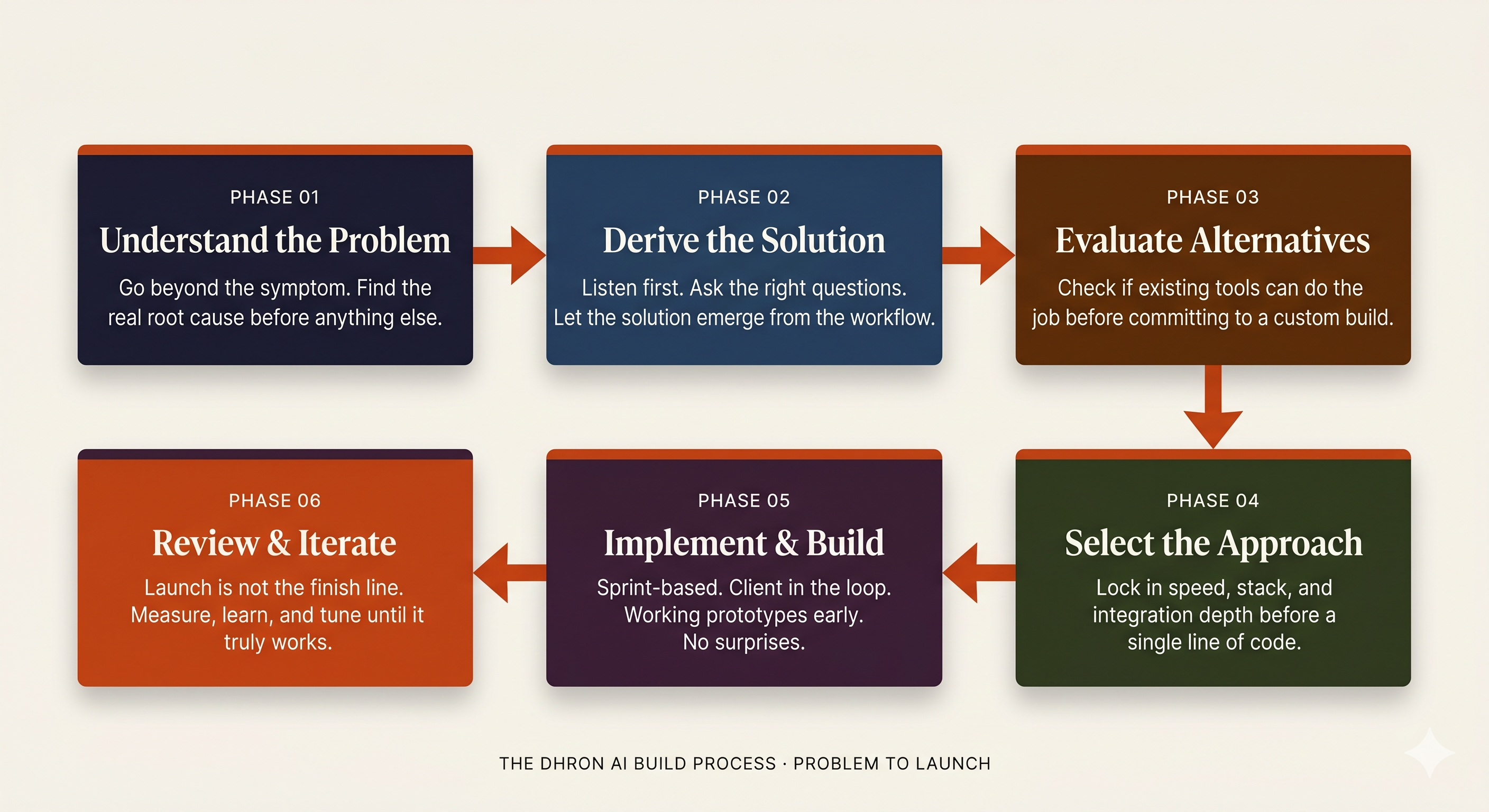
We've been sharing our build process step by step over the past few weeks — problem discovery, solution derivation, alternatives evaluation, approach selection, implementation, and review. Each phase on its own tells part of the story.
But the whole story is more powerful. So here it is — all six phases, walked through one real scenario, start to finish. By the end, you'll know exactly how Dhron AI turns a messy operational problem into custom tech that actually fits.
75%
of digital transformation projects fail to deliver on expectations, according to Gartner. The #1 reason: the technology chosen doesn't match the actual business process. Not budget. Not talent. Fit.
This is how we fix the fit problem.
The Company We're Building For
Meet SwiftRoute Logistics
SwiftRoute is a mid-sized last-mile delivery company operating across three cities. 60 drivers. 400+ deliveries a day. A operations team of 8 people trying to hold it all together.
On paper, they're growing. In reality, their entire dispatch operation runs on:
WhatsApp group chats
Excel route sheets
Phone calls for updates
Manual daily reports
Printed delivery manifests
Gut feel for ETAs
Missed deliveries. Duplicate routes. No live tracking. No way to know what's happening until a driver calls in or a customer complains. They knew something had to change. They just didn't know what — or how.
The Dhron AI Process
Six Phases. One Outcome.
01
Understanding the Problem
Go beyond the symptom. Find the actual root cause before anything else.
SwiftRoute: "We need better tracking" → Real problem: No single source of truth for dispatch, routes, or delivery status.
02
Deriving the Solution
Listen first. Ask the right questions. Let the solution emerge from the workflow, not from assumptions.
SwiftRoute: Mapped every touchpoint — from dispatch 6am to last delivery 10pm — across all 3 cities.
03
Evaluating Alternatives
Check if an existing tool can do the job before committing to a custom build.
SwiftRoute: Tested 3 off-the-shelf TMS platforms. None could handle their hybrid model of owned + contracted drivers.
04
Selecting the Approach
Lock in speed vs scalability, tech stack, and integration depth before writing a line of code.
SwiftRoute: Web dashboard for ops + mobile app for drivers. Integrated with their existing CRM and WhatsApp Business API.
05
Implementation
Sprint-based builds. Weekly check-ins. Working prototypes early. No surprises at the end.
SwiftRoute: Live prototype by Week 3. Ops team using it alongside WhatsApp by Week 6. Full cutover by Week 10.
06
Review & Iterate
Launch is not the finish line. Measure, learn, tune.
SwiftRoute: Post-launch data revealed peak delay window (11am–1pm). Automated re-routing
43%
reduction in failed deliveries in 60 days
2.5 hrs
saved per dispatcher per day
0
WhatsApp groups still in use for dispatch
The first version is never the last version. That's not a flaw — that's the process working exactly as it should.