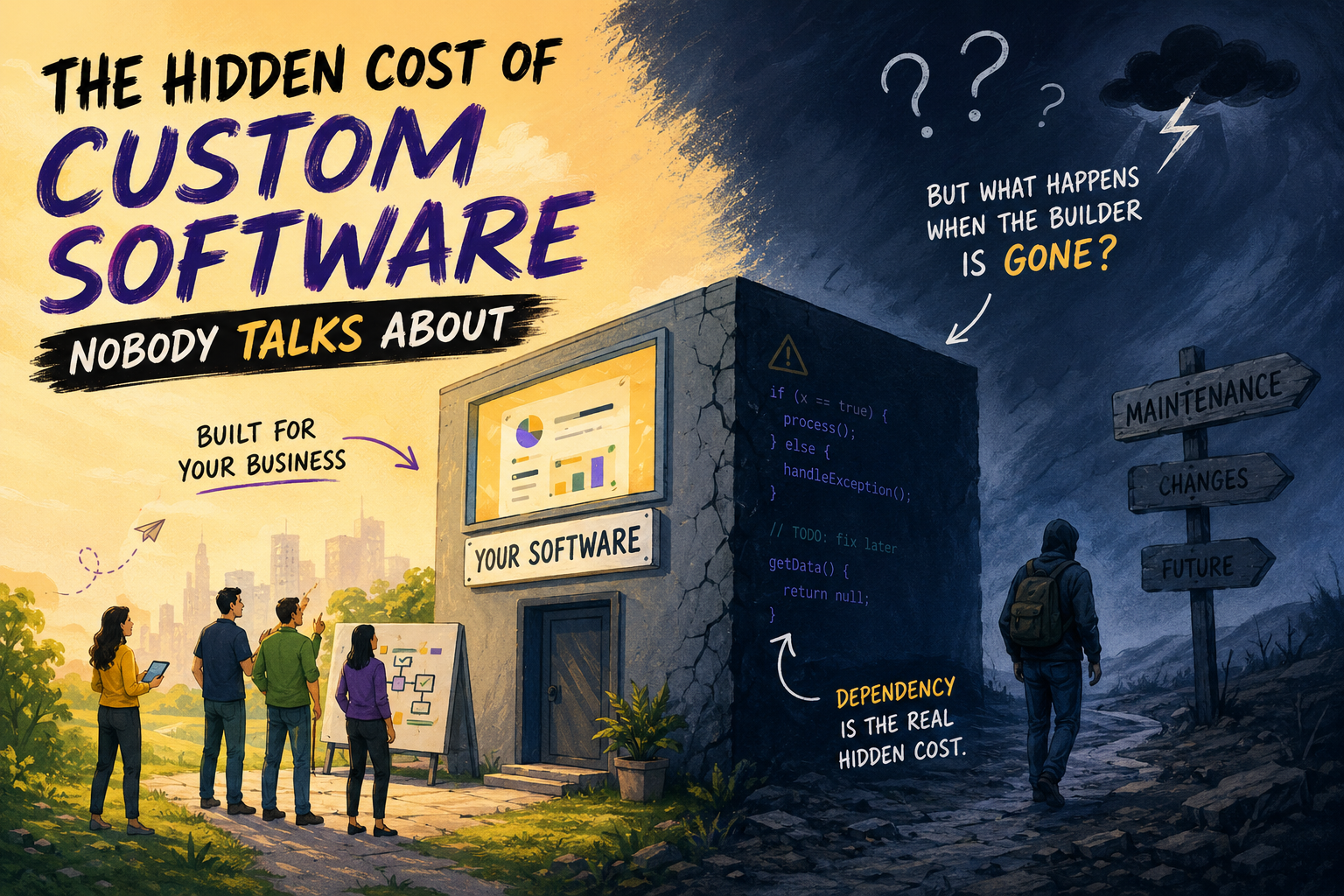
The Hidden Cost of Custom Software Nobody Talks About
Most enterprises worry about whether custom software will work. Few ask what happens when the people behind it disappear. A conversation with an enterprise owner revealed the hidden risk of custom software: not bad code, but dependency. In this blog, we explore the Bus Factor, why businesses often choose imperfect software, and how custom systems can be built for continuity—not just functionality.
An enterprise owner said something interesting during a discussion about custom software.
I expected him to talk about cost.
Or implementation timelines.
Or user adoption.
Instead, he said:
"The software worked perfectly. That's what worried me."
I was confused.
Most businesses complain that software doesn't fit their operations.
He had the opposite problem.
A few years earlier, his company had commissioned a custom ERP system.
The ERP wasn't just functional. It was built around how their business actually worked.
Employees didn't need weeks of training. Processes became faster. Teams adopted it quickly. Data entry reduced. The software fit the operation instead of forcing the operation to fit the software.
By every conventional measure, the project was a success.
Then the developer who built it left.
Another engineer took over. It took months for them to understand the system.
A year later, the software company itself shut down.
The ERP still worked.
But every future change suddenly became a risk.
Every bug became a concern.
Every new requirement became a question mark.
The software wasn't failing.
The company behind it was.
And suddenly those became the same problem.
Why This Is Not Actually a Software Problem
When enterprises evaluate technology, they often compare features.
Can it automate this?
Can it integrate with that?
Does it support our workflow?
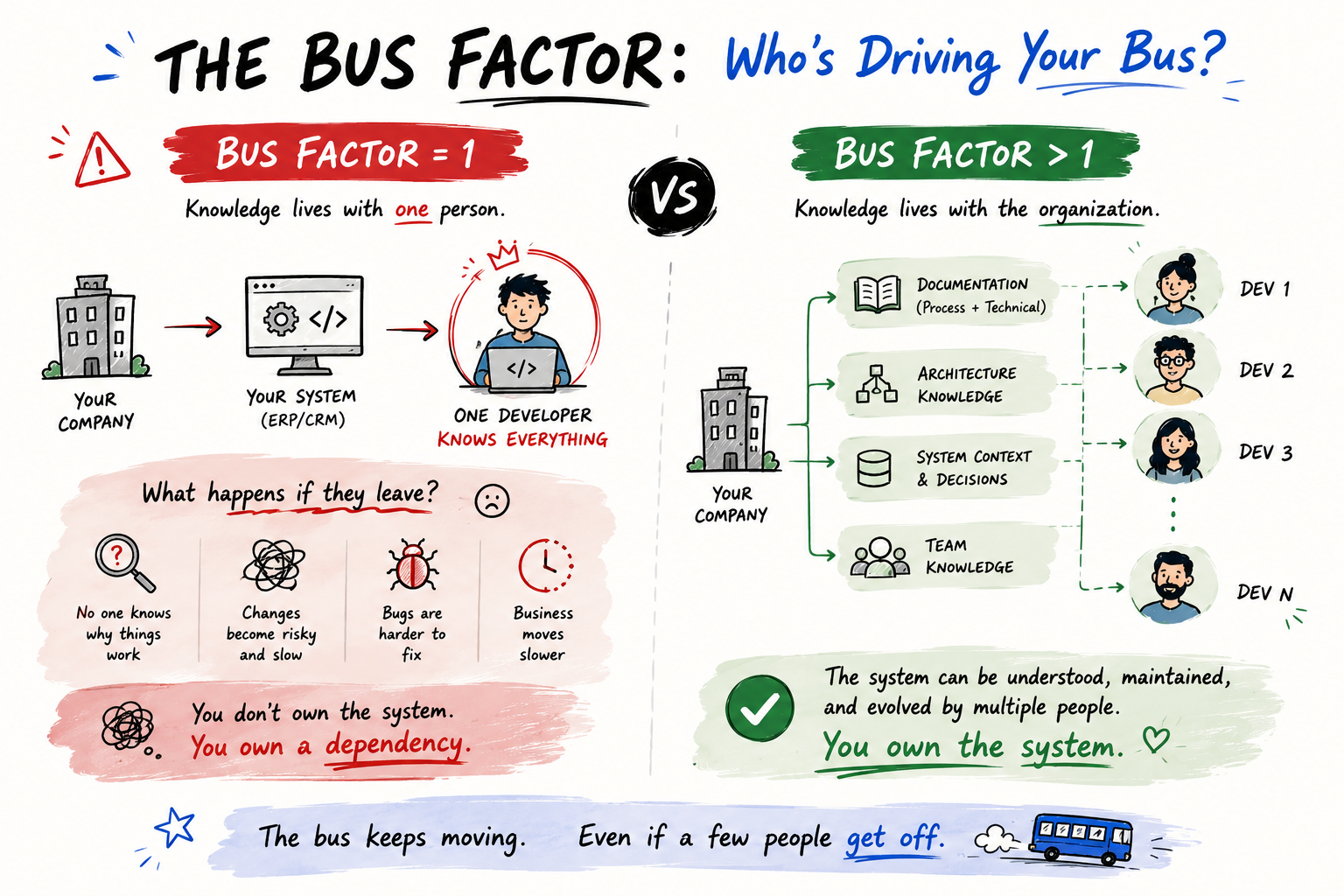
But software purchases are rarely just software purchases.
When a company adopts a CRM, ERP, or custom platform, they're also buying:
Support
Documentation
Knowledge transfer
Future upgrades
Business continuity
Take a platform like Zoho.
Most businesses don't choose Zoho because it's the perfect representation of how they operate.
In fact, many adapt their workflows to fit the platform.
Yet they still choose it.
Why?
Because they know:
Support will exist next year.
Documentation will exist.
Consultants will exist.
Developers will exist.
The company will probably still exist.
The real value isn't perfection.
It's predictability.
A CRM isn't just code.
It's a promise that somebody will still understand that code five years from now.
The Bus Factor: When Software Lives Inside One Person's Head
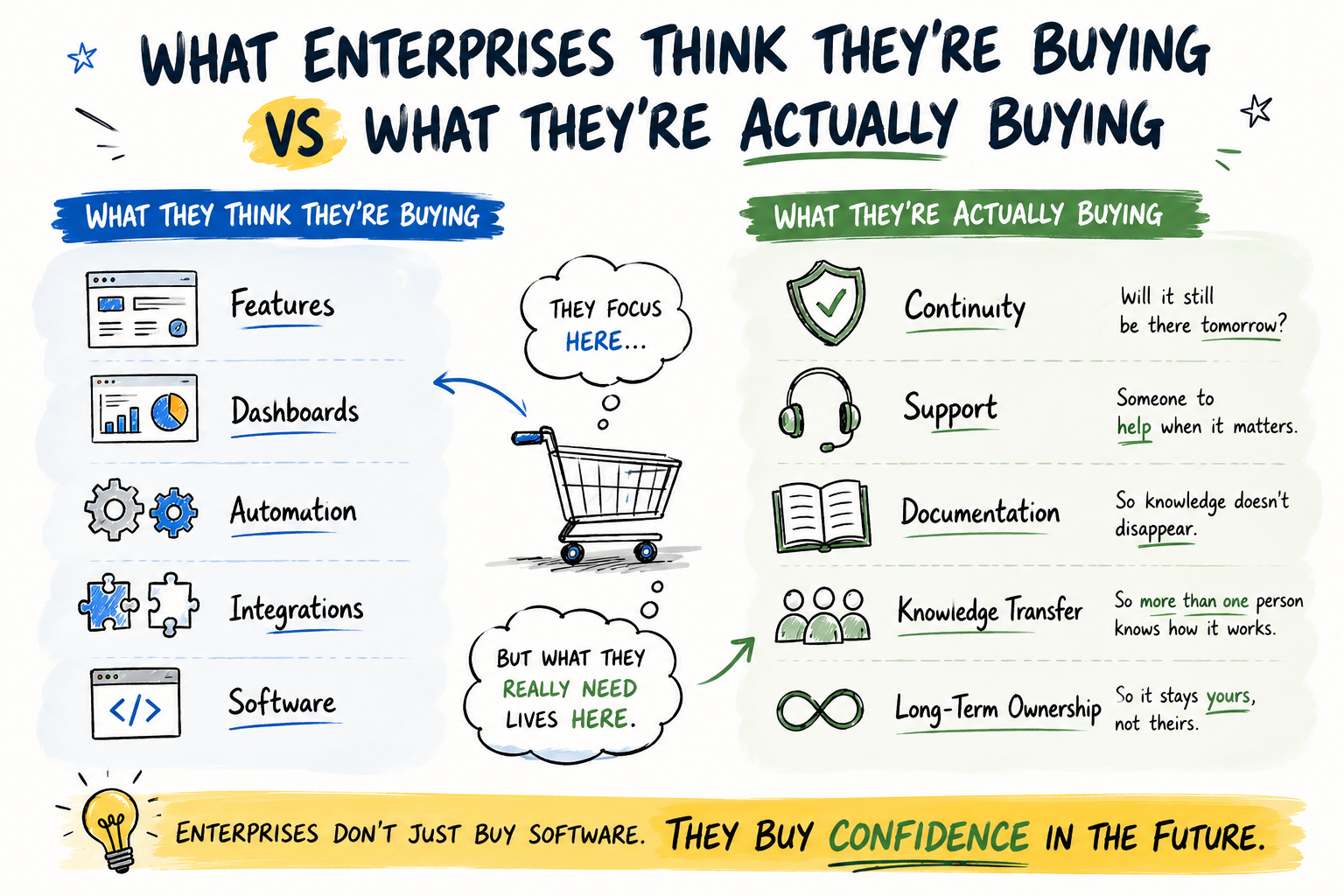
There's a concept in engineering called the Bus Factor.
It's a slightly dark name, but a very useful one.
The idea is simple:
How many people would need to disappear before a project becomes impossible to maintain?
Let's imagine your company has a custom ERP.
It handles:
Procurement
Inventory
Dispatch
Reporting
Vendor management
Over the years, dozens of business rules get added.
Special exceptions.
Custom approval flows.
Workarounds.
Integrations.
Logic that only exists because of how your company operates.
Now imagine only one person truly understands:
Why dispatch works a certain way
Why a specific approval flow exists
How inventory syncs between systems
Which integrations can safely be modified
That person leaves.
Nothing breaks immediately.
The system still runs.
Orders still move.
Reports still generate.
The real problem appears six months later.
A new business requirement comes in.
A regulation changes.
A workflow needs modification.
Suddenly nobody knows:
Where to make the change
What dependencies exist
What might break downstream
The software becomes a black box.
The Bus Factor isn't about software failure.
It's about knowledge failure.
And in custom software, knowledge is often more valuable than code.
If the answer to the Bus Factor question is "one", then the enterprise doesn't really own the system.
It owns a dependency.
Why Custom Software Companies Accidentally Create This Problem
Here's the uncomfortable truth.
Many software companies unintentionally create dependency.
Not because they're malicious.
Because they're focused on delivery.
The project gets completed.
The features work.
The client is happy.
Everyone moves on.
But very little attention gets paid to:
Documentation
Knowledge transfer
Maintainability
Vendor transitions
Long-term ownership
As a result, critical business knowledge ends up trapped inside:
A developer's head
Internal Slack messages
Old emails
Undocumented code
The software works.
But the organization becomes dependent on the people behind it.
Ironically, the better the software becomes, the bigger the risk.
Because now the business can't function without it.
Dependency is easy to create.
Continuity takes deliberate effort.
How We Think About This at Dhorn AI
That conversation with the ERP owner highlighted something important.
The real challenge isn't building software.
It's ensuring the software remains useful long after the original team is gone.
That's why we believe custom software should be designed around continuity from day one.
Not just functionality.
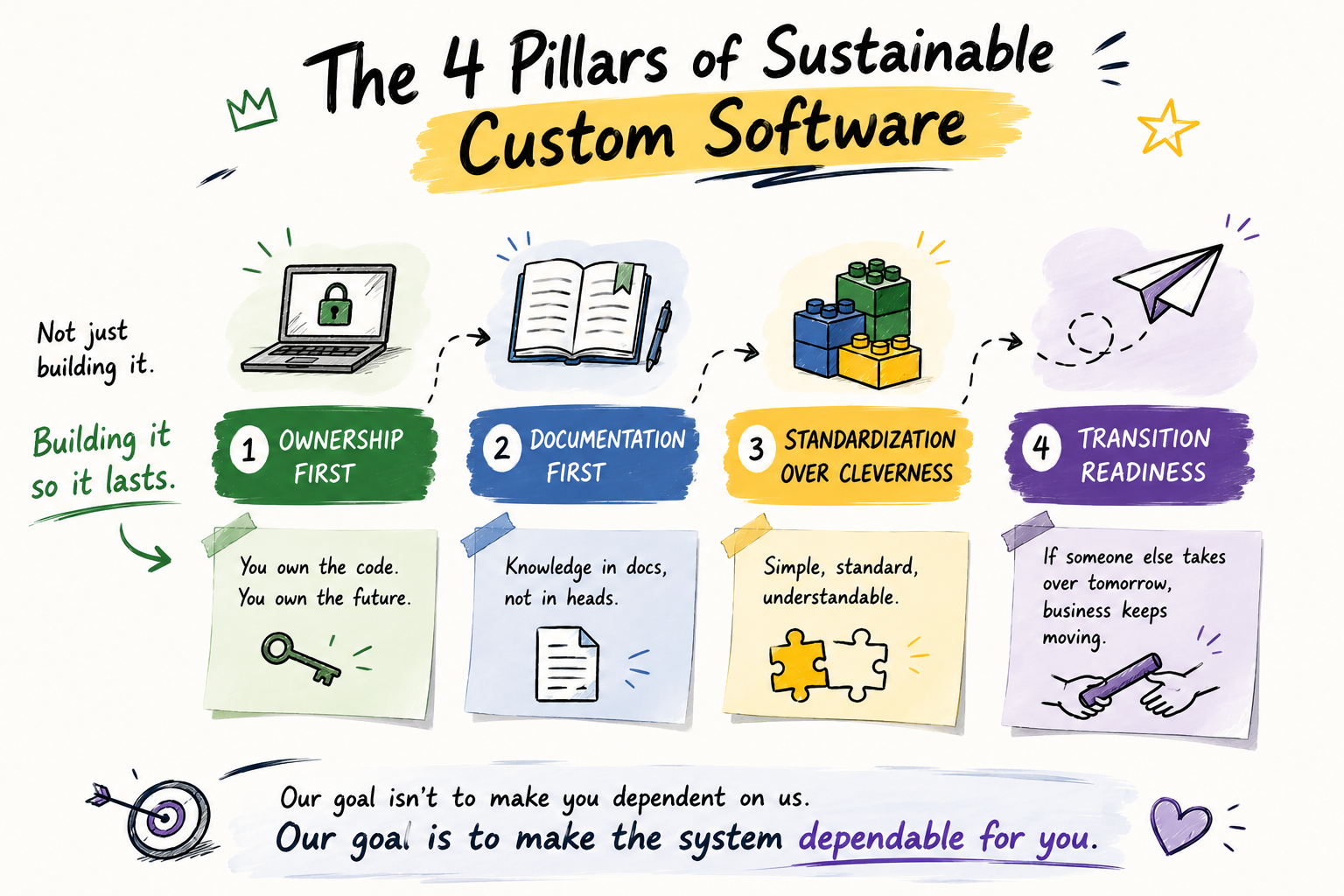
When we build systems, we work around four principles.
1. Ownership First
The system should belong to the client.
Not just operationally.
Technically too.
The goal is to ensure the business owns its future.
2. Documentation First
Knowledge should never live exclusively with developers.
Workflows, architecture, integrations, and business logic should be documented clearly.
If a new team takes over, they should be able to understand the system without starting from scratch.
3. Standardization Over Cleverness
The best systems aren't the most complex.
They're the most maintainable.
Using standard technologies and architectures makes future transitions significantly easier.
4. Transition Readiness
Every mission-critical system should have a continuity plan.
If another team needs to maintain it tomorrow, the business should keep operating.
The objective isn't to make clients dependent on us.
The objective is to make the system dependable for them.
The Question Enterprises Should Actually Be Asking
Most organizations ask:
Should we buy software?
Should we build software?
Should we customize software?
Those are important questions.
But they aren't the most important one.
A better question is:
If this software becomes mission-critical, what happens next?
Who owns it?
Who understands it?
Who can maintain it?
What happens if the original team disappears?
The answer to those questions often determines the long-term success of a technology investment far more than features ever will.
Because the hidden cost of custom software isn't development.
It's dependency.
And the best custom software isn't the one that fits your business perfectly.
It's the one that continues serving your business long after the people who built it are gone.